

Donna, your new release, Queen in Exile, is described as a Fantasy, can you tell us a little about the book?
It’s sort of a blend between a fairy tale and a medieval-style romance, mixed liberally with adventure. Here’s my official pitch: The last surviving member of her family, a princess must place her life, and the fate of her kingdom, into the hands of a trained killer. But accepting her destiny, and her own dark powers, will mean losing the man she loves.
In the past, you seem to have focused on Historical and Regency genres. What made you decide to try a Fantasy? How did you like writing Speculative Fiction as opposed to Historical?
I have loved fantasy almost as long as I have loved historical. I grew up reading both; the Laura Ingalls Wilder series, Jane Austen, Anne of Green Gable, and Jane Eyre, plus I adored fairy tales, which are very magical and have lots of fantasy elements. Then, a little later, I discovered authors such as Anne McCaffrey, David Eddings, Andre Norton, and Terry Brooks. So I grew up with two loves. When I started writing as a kid, I wrote fantasy because I loved being swept away into a totally new world. My fantasy novel was actually conceived when I was a junior in high school. About a hundred revisions (or more) later, Queen in Exile is the finished product. I like writing both genres; both are pretty much new worlds, since we don’t live in the same world as Regency England, so there’s a lot of imagination and world building required for both historical and fantasy.
What did you find were the major differences between the two? Was anything more or less difficult?
Both required extensive research, the Regency much more than the fantasy, of course, but I did research knights, weaponry, battle tactics and the Japanese Samurai Warriors, after whom my hero is patterned. There is a little more freedom with regards to research in fantasy. If I need something to happen in the fantasy story, I don’t have to stop and find out if that’s based on any sort of historical event or custom, so that part is really convenient.
On the subject of difficult, just how much research do you think is required to write effective, believable Regency Romance? (Readers, I am fascinated by the prospect, but fear the organization involved just might kill me)
I actually wanted to write historical novels all along, but was intimidated by the research required. But I had a story that just had to be told with characters demanding I tell it. So I read and re-read a lot of Jane Austin and Charlotte Bronte to help give me a good idea about the world and customs in which they lived, because they write books that took place during their time, so they weren’t making any historical inaccuracies, which one would normally find in a historical written today. I also joined a couple of on line Regency research groups where we discuss aspects of the era. I read a lot! It’s an on-going process and sometimes I learn things that make me wish I could go back and edit my previously-written books to correct mistakes.
That being said, I don’t think an aspiring historical author should wait until she/he thinks they know everything there is to know about that time period to write about it. Otherwise, they’d never write it!
Your book covers are stunning across the board. How much input did you have in designing them?
 Thank you! In all cases with both publishers, I was asked to submit detailed character descriptions, questions about the tone of the story, and a basic concept of the cover. In The Stranger She Married, they gave me a heroine with the eye color spot-on, but nothing about the rest of the cover was what I had envisioned. I liked it instantly, though. Queen in Exile included a castle, but that was about it as far as what I’d asked to have on the cover. The Guise of a Gentleman was almost exactly what I wanted, right down to the Jolly Roger waving across one corner.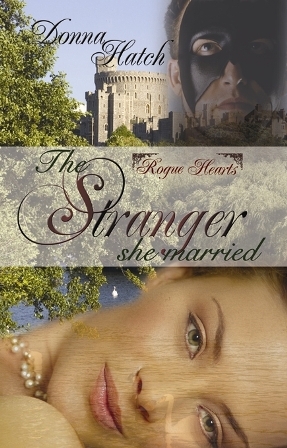
What other projects are you working on?
I’m working on book three of the Regency Series. It’s rough-drafted and I’ve just begun revisions and edits. I’ve also started writing a dark young adult paranormal. No, there are no vampires ;-)
Do you have any favorite advice to give for the aspiring authors out there?
Be persistent. Most people have dreams of writing a novel, but never finish one. Most people who finish a novel never submit it, and most who submit, give up after a few rejections.
I wish you the greatest success with the new book! Can you tell us where we can find it?
You can find my books at Amazon, Barnes & Noble, and my website www.donnahatch.com. Queen in Exile is also available at Costcos across the country. The Guise of a Gentleman is also available at www.thewildrosepress.com Here is the direct link to my book page. The Wild Rose Press
I’m also running a contest to win a book for free and you have five chances if you do all five, or you can just do one or a few:
1. go to my website and then find out what is the name of the hero of The Guise of a Gentleman (hint, read the backcover blurb underneath the book cover), then send me an email at donnahatch29@gmail.com, telling me the answer to the question and put "free book" in the subject line
2. go to my website and then find out what is the name of the hero of Queen in Exile (hint, read the backcover blurb underneath the book cover), then send me an email at donnahatch29@gmail.com, telling me the answer to the question and put "free book" in the subject line.
3. Follow my blog, then send me an email at donnahatch29@gmail.com, telling me you're now following me and put "free book" in the subject line.
4. Leave a comment in my blog, www.donnahatch.blogspot.com. Then send me an email at donnahatch29@gmail.com and put “free book” in the subject line.
5. Friend me on Facebook, Click here then send me an email at donnahatch29 at gmail dot com, telling me you're now my friend on Face book and put "free book" in the subject line.
Remember, for each thing you do, you have another chance to win. Good Luck!!!
Thank you, Donna for joining us. You can find Donna’s books at Amazon, Your local bookstore, and her website, www.donnahatch.com. Queen in Exile is also available at Costcos across the country.


